

OVERVIEW
Cells are the basic unit of life. Based on the idea of ‘understanding by building’, artificially constructing cell structures using biomolecules as building blocks helps to understand the working mechanism of cells and provides clues for the origin of life. An artificial cell is a simplified model of a cell, which refers to a cell-like structure that mimics some (or all) of the cell functions. The goal of the artificial cell synthesis field is to build a living structure from scratch that can autonomously exchange material and energy with its environment and realize its growth and reproduction. (1) Material and energy supply, (2) cell membrane growth, and (3) multi-generational replication are three important characteristics of life. The goal of this project is to achieve multi-cycle reproduction of a self-powered artificial cell through comprehensive collaboration among researchers participating in this program (Figure, left). And at the same time, our team in the A3 Foresight Program aims to establish a world-leading artificial cell synthesis research team, A3 Alliance for Artificial Cells (A3C), securing a top position in the global scientific community (Figure, right).
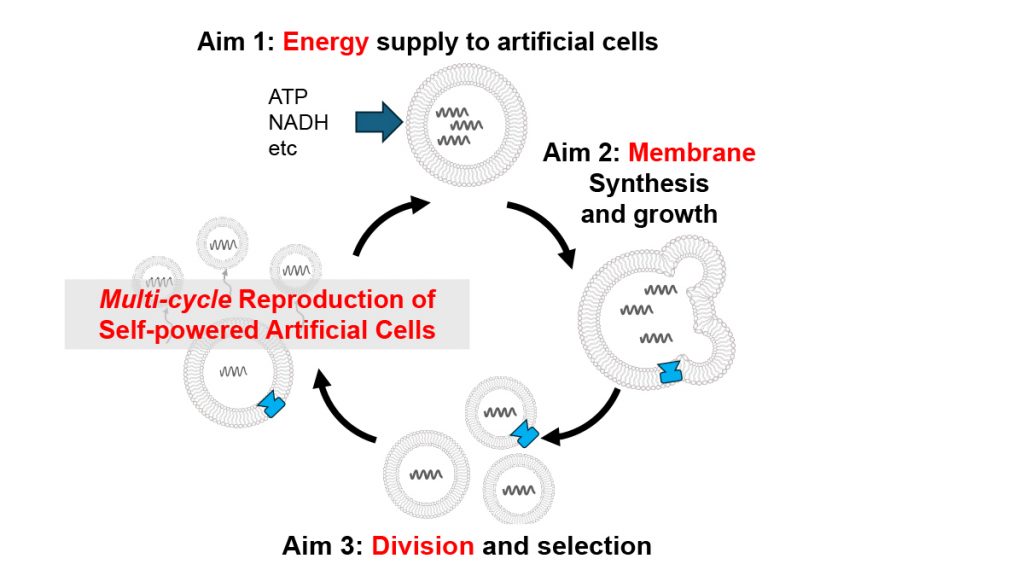
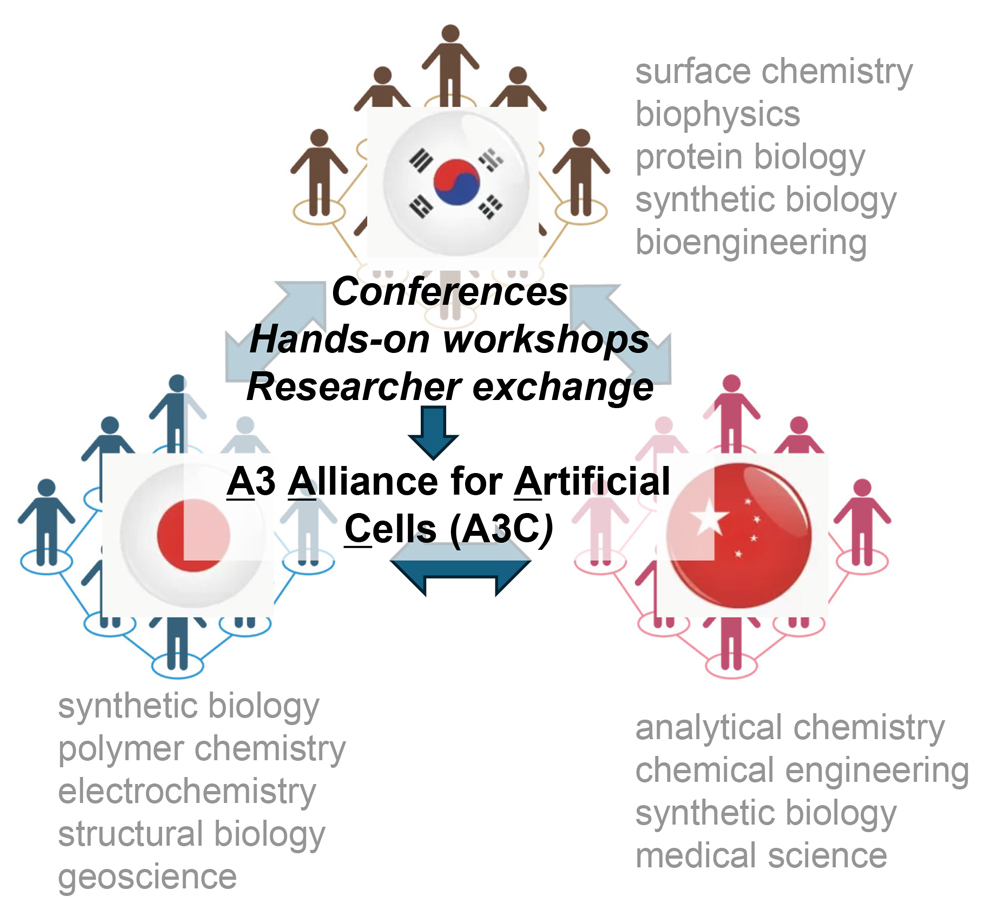
Figure: Schematic of the project. Researchers with diverse expertise collaborate to create artificial cells capable of autonomous proliferation and evolution (left). This challenge is being tackled by researchers from Japan, China and Korea through the A3C (Alliance for Artificial Cells) organization (right).
PRINCIPAL INVESTIGATORS
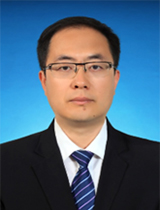
Xiaojun Han
Head of Chemistry Department in Harbin Institute of Technology, China
Expertise:
molecular assembly, artificial cells. Xiaojun and his team and his team’s research includes complicated metabolism pathway reconstitution in artificial cells, signal transduction, and artificial cell growth and division.
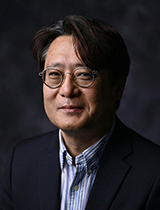
Kwanwoo Shin
President of Research and Business Development Foundation in Sogang University, Korea
Expertise:
Artificial cells, with particular interest in cell-free expression systems, cytoskeletal organization and sustainable energy generation in protocell models. His group has created artificial organelle mimics that couple light-harvesting proteins and ATP synthase to drive biochemical reactions in synthetic systems.
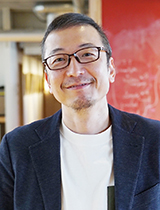
Tomoaki Matsuura
Associate Director of Earth-Life Science Institute (ELSI)
Institute of Science Tokyo, Japan
Expertise:
Artificial cells, directed evolution, membrane proteins, and membrane biophysics. His interest is to build molecular systems from defined components and understand the fundamental features of living systems.